
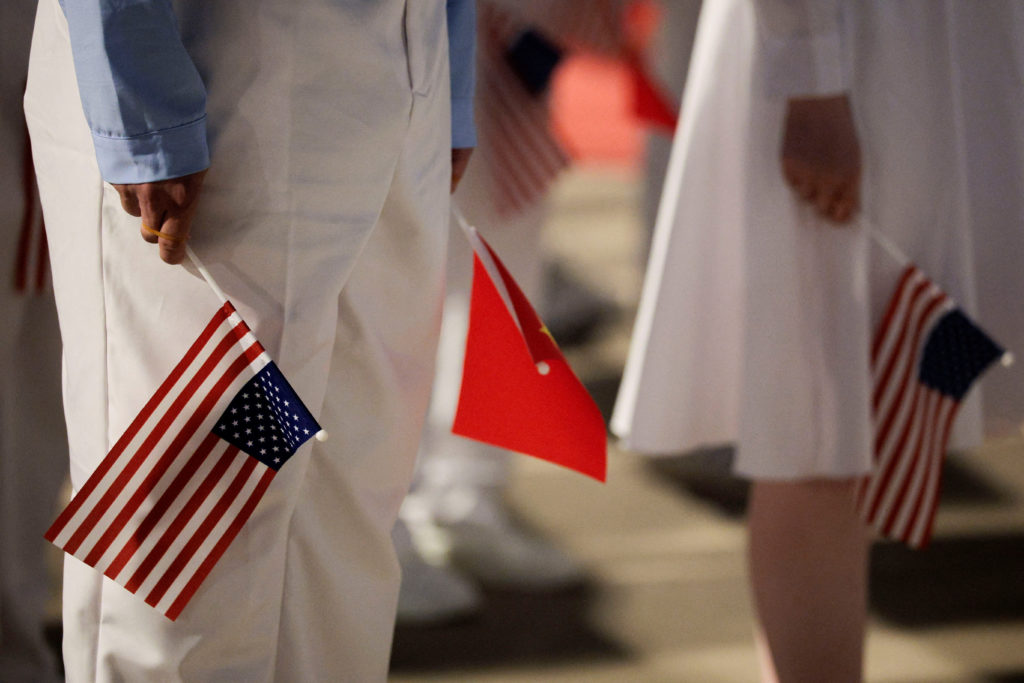
President Donald Trump and President Xi Jinping are meeting in Beijing in an effort to steady a trade relationship that was battered during a turbulent 2025. The two governments are trying to repair some of the damage from a tariff war that pushed bilateral trade into a freefall and exposed the economic cost of confrontation between the world’s two largest economies.
What Happened
The meeting in Beijing brings the leaders of the United States and China together at a moment when both countries have strong incentives to reduce tensions. After months of escalating tariffs and countermeasures in 2025, trade between the two sides weakened sharply, disrupting commercial flows that are central to global manufacturing, shipping, agriculture and technology supply chains.
Trump and Xi are using the talks to explore ways to restore stability and improve economic ties after the trade conflict strained relations well beyond customs duties. A prolonged tariff fight between Washington and Beijing can affect prices, investment decisions and sourcing strategies across the global economy, and it often ripples through third countries that depend on both markets.
Background
U.S.-China trade relations have long been marked by competition over market access, industrial policy, and technology. Tariffs became a major tool in that rivalry during Trump’s first term, and later rounds of confrontation have repeatedly unsettled investors and multinational companies. When the two countries impose duties on one another, the impact is rarely contained to their own borders: companies reroute shipments, manufacturers hunt for alternatives, and governments around the world prepare for slower growth.
For China, the U.S. remains one of its most important export markets. For the United States, China is a major source of consumer goods, industrial inputs, and critical components used in everything from electronics to machinery. That interdependence helps explain why trade wars can inflict damage on both sides even when they are intended to create leverage.
The Beijing meeting also comes at a time when governments across Latin America are watching U.S.-China relations closely. Many countries in the region, including Panama, depend on global trade flows and on stable economic conditions that support shipping through key routes such as the Panama Canal. When the world’s largest economies clash, the effects can be felt in freight volumes, commodity demand, and business confidence far beyond Asia and North America.
Why It Matters
Any attempt to repair the U.S.-China trade relationship matters because the fallout from a tariff war reaches well beyond Washington and Beijing. A less confrontational approach could help calm markets, improve supply-chain predictability and reduce pressure on exporters and importers that rely on cross-border trade.
For Latin America, the stakes are especially high. The region’s economies are sensitive to shifts in global demand, shipping patterns and commodity prices. Panama, as a logistics hub and canal nation, benefits when world trade moves smoothly and suffers when major economic powers create uncertainty that can slow cargo flows or weaken commercial confidence. A thaw between the United States and China would not solve those structural vulnerabilities, but it could reduce one of the most important sources of global trade disruption.
The talks in Beijing are therefore being watched not just as another diplomatic encounter, but as a test of whether the two superpowers can pull back from economic conflict and prevent further damage to the global trading system.