
What Happened
Panama continues to recognize the People’s Republic of China rather than Taiwan, a diplomatic shift that has shaped the country’s foreign policy since 2017. The decision reflected Beijing’s growing economic influence in the region and marked a break from Panama’s former ties with Taipei.
At the same time, Panama has kept informal channels open with Taiwan through limited cooperation in trade, investment, and academic exchange. That balancing act has become more visible as lawmakers and local actors have shown interest in Taiwan’s expertise and business opportunities.
Diplomatic Tensions in Panama
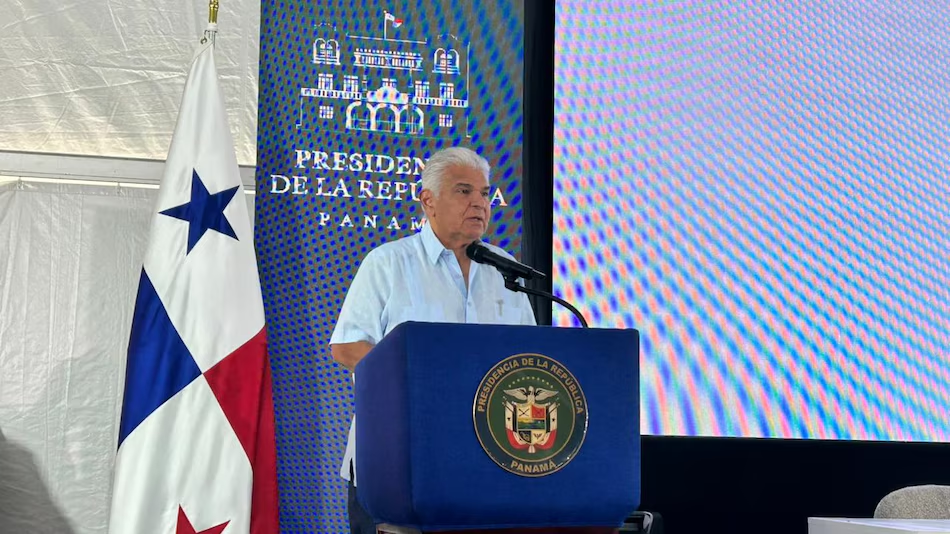
The issue resurfaced in 2025 when a planned trip by Panamanian lawmakers to Taiwan stirred tension with China. The Chinese embassy in Panama urged the delegation to cancel the visit, citing the “one China” principle. President José Raúl Mulino said the trip did not have his administration’s formal approval, while Panama’s Foreign Ministry rejected what it described as outside pressure on internal matters.
The episode highlighted a familiar challenge for Panama: maintaining its official alignment with Beijing while preserving room for practical contacts with Taiwan. That approach reflects both geopolitical reality and the country’s interest in expanding economic options.
Xi’s Warning on Taiwan
In Beijing, Chinese President Xi Jinping warned President Donald Trump that the United States and China could come into conflict over Taiwan. The exchange underscored how deeply the issue divides the world’s two largest economies and how central Taiwan remains to Beijing’s strategic concerns.
Taiwan is self-governed but claimed by China as part of its territory. Washington has long maintained unofficial relations with Taipei and supports stability in the Taiwan Strait, which remains one of the most sensitive flashpoints in global politics.
Why It Matters for Panama
A confrontation over Taiwan would reach far beyond East Asia. It could disrupt shipping, financial markets, and technology supply chains, especially because Taiwan plays a major role in semiconductor manufacturing. For Panama, any shock to global trade would carry direct consequences because of the Canal’s importance to international commerce.
Panama’s position also reflects a broader Latin American reality. Countries across the region continue to weigh ties with China against long-standing relations with the United States. As rivalry between Washington and Beijing intensifies, that balancing act is likely to become even more difficult.