
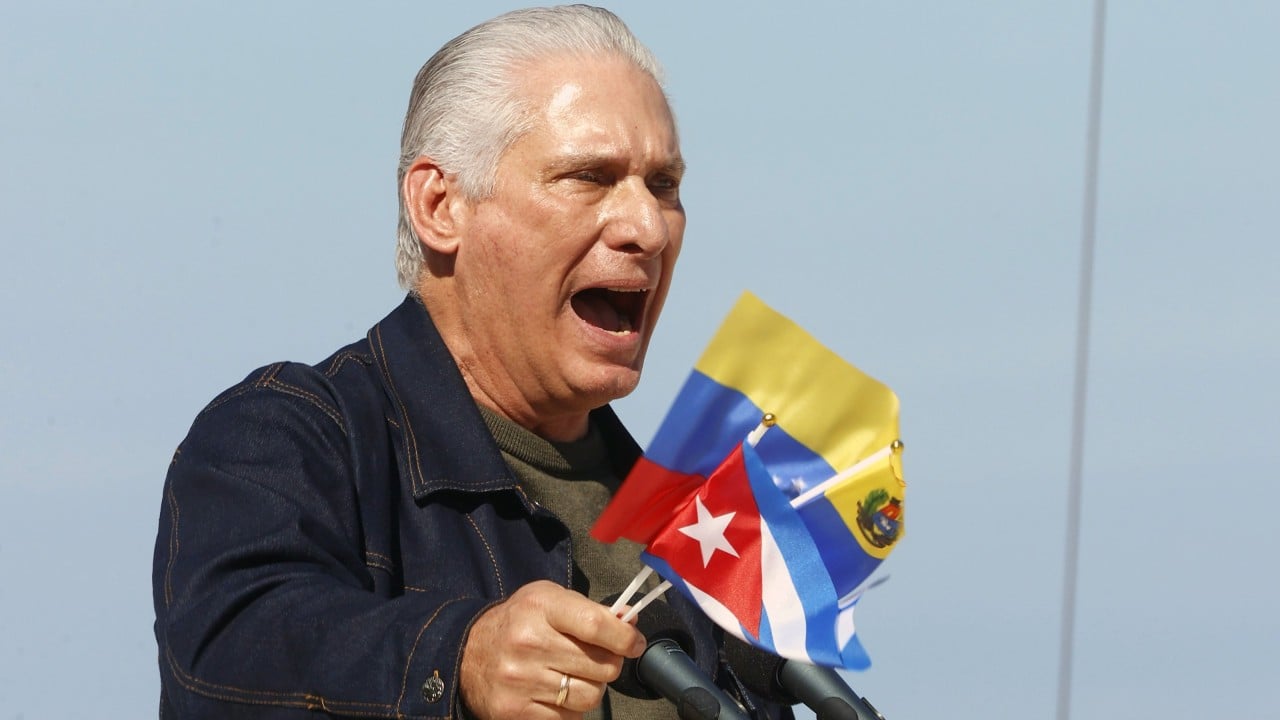
Cuban President Miguel Díaz-Canel has warned the United States against any military attack on Cuba or any effort to remove him from power, saying such a move would carry heavy costs and destabilize regional security. In a U.S. television interview, he argued there is no valid justification for an invasion and said Cubans would defend the island if attacked.
What Happened
Speaking on NBC News’ Meet the Press, Díaz-Canel pushed back against the idea of U.S. military action against Cuba. He said an invasion would be expensive, dangerous, and harmful not only to Cuba but to security across the Caribbean and the wider region. He also rejected any suggestion that Washington should try to depose him.
In the interview, Díaz-Canel said that if a military confrontation were forced on Cuba, the country would respond in self-defense. His comments were framed as a direct warning to the United States and as a defense of Cuba’s sovereignty.
Background
Cuba and the United States have had a tense and often hostile relationship for decades, shaped by the 1959 Cuban Revolution, the Cold War, the failed Bay of Pigs invasion, the U.S. embargo, and repeated disputes over human rights, migration, and sanctions. Although relations have periodically improved, deep mistrust remains a defining feature of the bilateral relationship.
U.S. policy toward Cuba has long been a sensitive issue in Latin America and the Caribbean, where military intervention by major powers is widely viewed as a destabilizing threat. Any suggestion of force against Cuba would likely revive memories of past confrontations and raise alarms across the region, particularly in countries that depend on stable trade routes, migration flows, and maritime security in the Caribbean basin.
Díaz-Canel, who became Cuba’s president in 2018 after succeeding Raúl Castro, leads a government that has faced sustained economic pressure, sanctions, and internal criticism. His remarks come against the backdrop of enduring disputes between Havana and Washington over Cuba’s political system and the role of the United States in the island’s future.
Why It Matters
The warning underscores how quickly U.S.-Cuba tensions can take on wider geopolitical significance. Even without an immediate military threat, statements like these can deepen uncertainty in the Caribbean and renew debate over the use of force, sovereignty, and foreign intervention in the Western Hemisphere.
For Panama and the region, stability in the Caribbean matters because it affects trade, shipping, migration, and diplomatic relations across Central America and Latin America. A severe escalation involving Cuba and the United States would reverberate far beyond the island, potentially complicating regional security cooperation and adding pressure to already delicate hemispheric relations.
The comments also highlight how unresolved the U.S.-Cuba standoff remains. More than six decades after the revolution, Cuba continues to view itself as under external threat, while U.S. policy remains shaped by a mix of sanctions, political pressure, and periodic calls for change on the island. That enduring confrontation keeps Cuba at the center of one of the hemisphere’s most persistent geopolitical fault lines.