
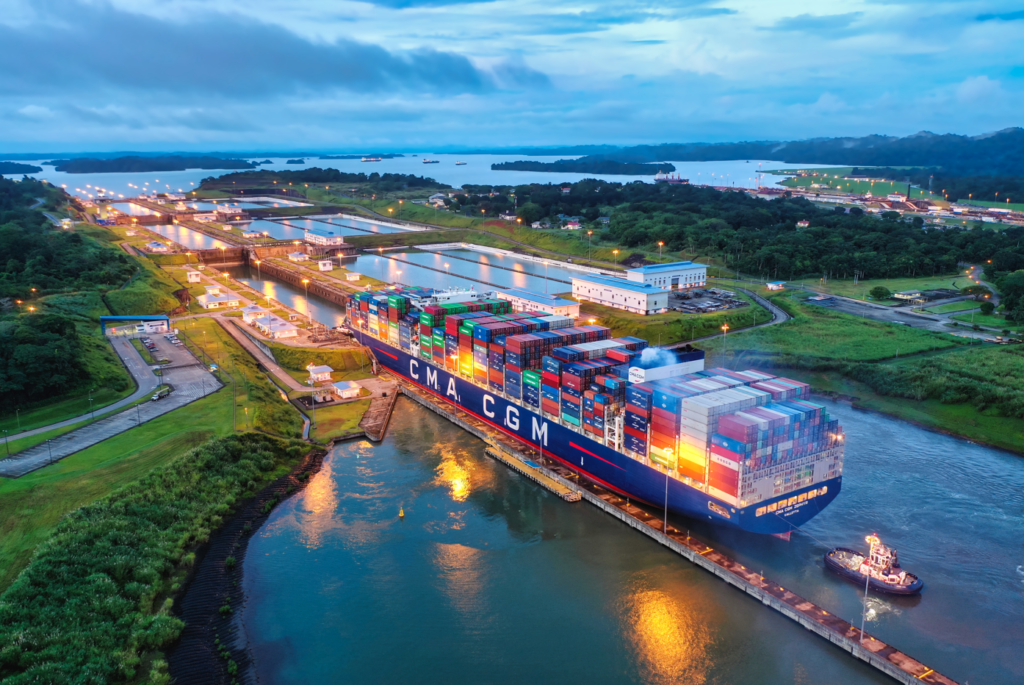
The Panama Canal Authority (ACP) has announced a major expansion of its Long-term Slot Allocation (LoTSA) program, extending advance transit booking to both sets of locks for the first time. The new phase covers the dry season period from January 3 to April 3, 2027, and introduces a LoTSA Panamax Pilot Program alongside the established LoTSA Neopanamax offering.
What Happened
The announcement marks the first time the long-term slot allocation mechanism will reach both the Neopanamax and Panamax locks. LoTSA Neopanamax continues the program already familiar to Canal customers, while the new Panamax pilot extends the same opportunity to vessels transiting the older, smaller locks.
Both programs will be awarded through sealed-bid competitions supported by a specialized customer service team. The LoTSA Neopanamax competition is scheduled for November 17, 2026, while the LoTSA Panamax pilot competition will take place on November 24, 2026.
Under the Neopanamax program, the Canal will offer 36 packages containing a total of 270 slots — 165 northbound and 105 southbound — equivalent to three daily transit slots distributed across different packages.
The Panamax pilot program will offer 51 packages totaling 288 slots, with 147 northbound and 141 southbound transits, also equivalent to three daily transit slots throughout the program period under a single flexibility level. The Panamax packages will use the same allocation mechanism, selection criteria, and tie-breaking rules already applied to the Neopanamax program.
The Canal Authority emphasized that remaining transit capacity will continue to be offered through the regular Reservation System and Auction process, as is currently the case.
Background
The Panama Canal handles a significant share of world maritime trade, connecting the Atlantic and Pacific oceans and serving as a critical artery for container shipping, liquefied gas carriers, and bulk cargo. Its two lock systems serve different vessel sizes: the Panamax locks, dating to the Canal’s original 1914 construction, and the larger Neopanamax locks, opened in 2016 as part of the Canal’s expansion.
The LoTSA program was developed to give customers greater predictability when planning operations, allowing them to secure transit slots in advance during the dry season. Advance slot reservations help shipping lines and cargo owners firm up itineraries and simplify logistics planning.
The program takes on added importance given the Canal’s ongoing water challenges. The waterway relies on Gatun Lake rainfall to operate its locks, and prolonged drought conditions in recent years forced the ACP to restrict daily transits and draft limits, disrupting global supply chains. The Authority has since implemented measures to ensure the sustainability of its operations in response to climatic conditions affecting water availability, making predictable slot allocation a key tool for managing constrained capacity.
What This Means for Panama
The extension of LoTSA to the Panamax locks signals the Canal’s continued push toward more structured, market-based capacity management across its entire infrastructure. By covering both lock systems, the program gives a wider range of customers — from smaller tankers and bulk carriers to the largest container ships — the ability to lock in transit certainty months ahead.
For the Canal’s revenues, sealed-bid competitions during the high-demand dry season can capture premium pricing for guaranteed slots, strengthening the ACP’s financial position as it invests in water-security solutions.
For shippers and logistics planners, the key dates to watch are the two sealed-bid competitions in November 2026. Full program details are available on the Canal’s website at pancanal.com/en/lotsa.
This story was originally reported by Panama Canal Authority.