
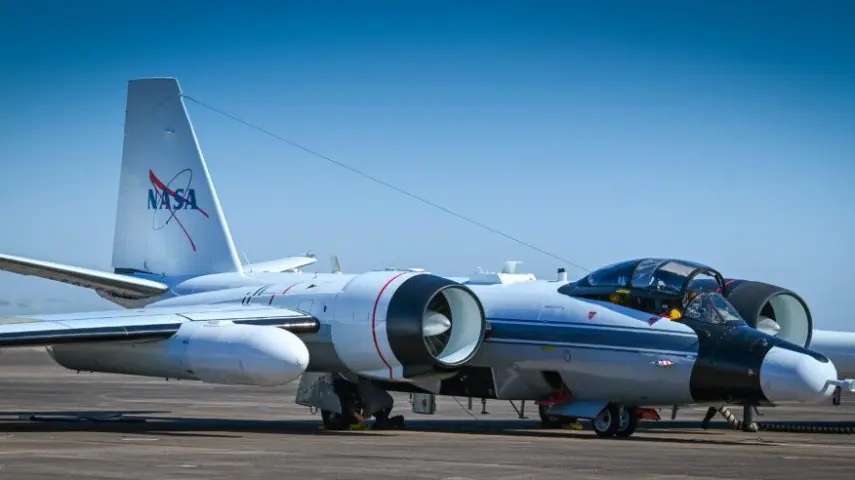
A high-altitude NASA research aircraft has been flying scientific missions over Panama since late August, using the country’s strategic tropical location to gather data on aerosols, atmospheric gases, and the ozone layer as part of a joint U.S. government mission running through September 23.
What Happened
According to the U.S. Embassy in Panama, NASA’s WB-57 research aircraft is operating in the country from August 24 to September 23 in support of the SABRE mission, a scientific campaign led by the U.S. National Oceanic and Atmospheric Administration (NOAA) in collaboration with NASA.
The aircraft is based at Panama Pacific International Airport and carries out scientific flights over the region to study the tropical atmosphere. It is equipped with more than 17 instruments designed to measure aerosols, atmospheric gases, ozone, water vapor, and meteorological conditions.
During its operations, the WB-57 typically flies at altitudes between 13 and 19 kilometers — the upper troposphere and lower stratosphere — and is expected to carry out approximately three scientific flights per week, depending on atmospheric and meteorological conditions.
U.S. Ambassador to Panama Kevin Marino Cabrera highlighted the value of the mission, stating: “Having better atmospheric data means better information for American scientists; better models to understand the climate and a greater scientific advantage for the United States.”
Background
The SABRE mission focuses on how aerosols — tiny particles suspended in the air — form, move, and transform in the upper layers of the atmosphere. This region is of particular scientific importance because it contains the ozone layer, which protects life on Earth by absorbing harmful ultraviolet radiation from the sun.
Panama’s geographic position makes it an exceptional natural laboratory for this kind of research. The country sits near the Intertropical Convergence Zone (ITCZ), a band of converging trade winds near the equator that drives some of the planet’s most intense weather. The region also experiences deep atmospheric convection north of South America, where powerful thunderstorms can loft air and particles from the surface deep into the upper atmosphere.
The WB-57, originally derived from a Cold War-era bomber design, is one of the few aircraft capable of sustained flight at such high altitudes, allowing it to directly sample air in regions that satellites and lower-flying planes cannot reach.
What This Means for Panama
The mission reinforces Panama’s role as a hub for international atmospheric and climate science. Its location allows researchers to collect data on tropical atmospheric conditions that are difficult to obtain elsewhere, potentially strengthening the country’s profile as a partner in global scientific research.
The flights, operating roughly three times per week through September 23, may be noticeable to residents near Panama Pacific International Airport. Beyond the mission window, the data collected over Panama will feed into models used to understand climate behavior and the chemistry of the upper atmosphere — research that ultimately informs understanding of ozone protection and climate processes worldwide.
This story was originally reported by Newsroom Panama.