
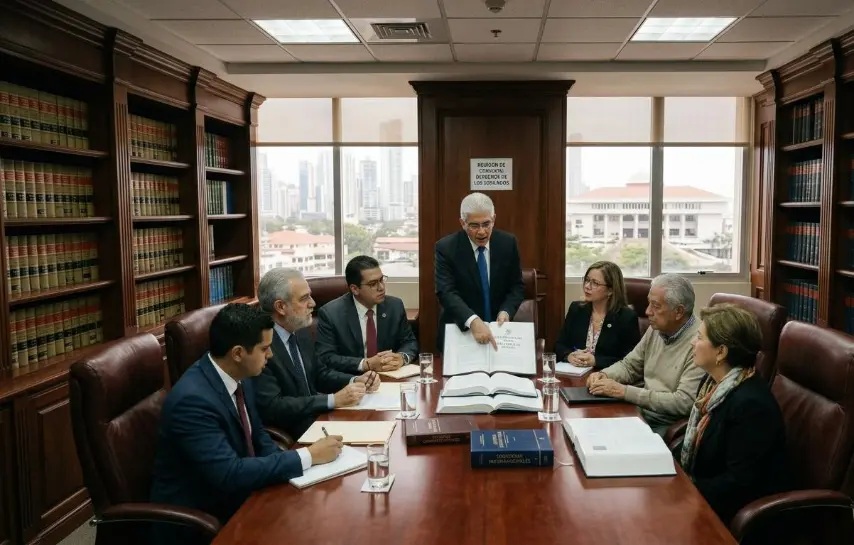
Prominent Panamanian lawyers and former union leaders are pushing back against proposals that would force retirees out of their jobs, warning that any initiative making retirement an automatic cause for dismissal would violate the Constitution and squander decades of accumulated public sector experience.
What Happened
The legal experts agreed that the ongoing debate over generational renewal in the state labor market should be resolved through job creation and merit-based hiring — not by pitting young workers against retirees in a competition for the same positions.
Juan Carlos Araúz, lawyer and former president of the National Bar Association, argued that establishing mandatory retirement based solely on age “would be a mechanism of labor exclusion.” He explained that retirement is an acquired right that should not be transformed into a sanction or a presumption of incapacity.
“Acquiring the right to a pension is one thing, but losing the capacity or the right to continue working is quite another,” Araúz stated.
Araúz pointed to a Supreme Court ruling of December 6, 2019, which declared that retirement does not constitute an incompatibility with continuing to work. He added that any renewal policy should rest on performance, suitability, and evaluations rather than age.
Lawyer Felipe Cabeza went further, calling the exclusion of retirees a “mistake” and warning it would be unconstitutional. “The accumulated wisdom of years of work would be lost,” he said. Cabeza noted that 99.9% of public servants do not retire because their pensions do not cover basic expenses such as food and medicine. His proposed “dignified solution” would allow long-serving employees to retire with 100% of their salary, paired with a constitutional revision establishing a conditional working cap.
Background
Panama has a long legal history on this question. In 2005, the Supreme Court declared the last paragraph of the so-called Faúndes Law — enacted in 1998 — unconstitutional on grounds of discrimination. That law had required public servants to retire from their positions upon reaching age 75.
Law 40 of August 20, 2007, formally repealed those regulations. Article 2 of the law states that “no state institution may require the resignation of a public servant as a prerequisite for receiving retirement or an old-age pension, nor may it require it after the employee has already received that benefit.”
Law 18 of 2008 subsequently eliminated mandatory retirement at age 75 altogether. Earlier Supreme Court rulings of partial unconstitutionality, together with reforms approved during the 2000s, also exempted certain sectors — such as university professors and diplomats — from the restriction.
The Constitution itself protects the right to work as well as the principles of equality and non-discrimination, forming the legal backbone of the lawyers’ arguments.
What This Means for Panama
The lawyers’ intervention signals that any legislative effort to remove retirees automatically from public posts is likely to face immediate legal challenges before the Supreme Court, given the precedent set in 2005 and 2019.
The debate also highlights a deeper structural issue raised by Cabeza: many public servants simply cannot afford to retire because their pensions fall short of covering basic living costs. This means that policies focused solely on removing older workers, without addressing pension adequacy, could leave long-serving employees in financial hardship while depriving the state of experienced personnel.
The path forward suggested by the lawyers emphasizes job creation for young Panamanians and merit-based evaluation for existing employees — an approach they argue is both constitutional and more productive than age-based exclusion. Whether lawmakers will pursue pension reforms, such as Cabeza’s proposal for full-salary retirement benefits, remains a key question for the country’s public sector workforce.
This story was originally reported by Newsroom Panama.