
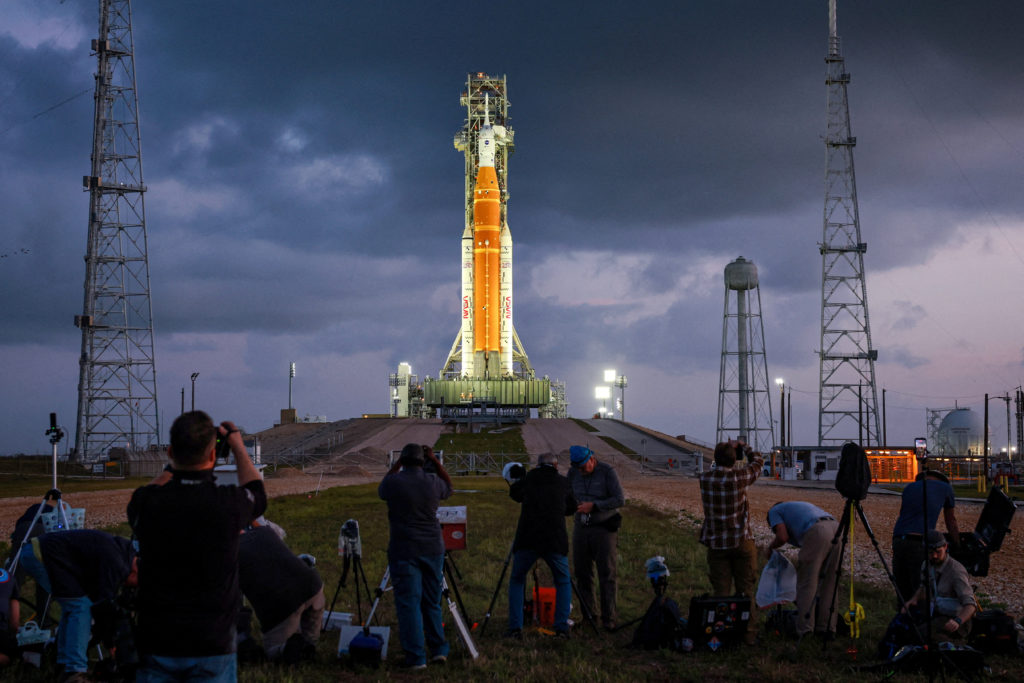
NASA has begun fueling its moon rocket ahead of the planned launch of Artemis II, a mission that would send four astronauts around the Moon for the first time in more than half a century. The launch marks a major step in the United States’ effort to return humans to deep space and ultimately land on the lunar surface again.
What Happened
Fueling began Wednesday for the heavy-lift rocket assigned to Artemis II, the next crewed flight in NASA’s Artemis program. The mission is designed to carry four astronauts on a journey around the Moon and back, a trajectory that will test the systems needed for future lunar exploration.
The evening liftoff target comes after years of development tied to NASA’s broader push to rebuild the nation’s human spaceflight capability beyond low-Earth orbit. Artemis II is the first crewed lunar mission in more than 50 years, reviving an era of exploration that ended with the Apollo program.
Background
The Artemis program is NASA’s successor to Apollo and is meant to establish a sustained human presence in deep space. The first Artemis mission flew without astronauts and helped demonstrate the rocket and spacecraft systems needed for later crewed flights.
Artemis II will be a critical proving mission. Sending astronauts around the Moon, rather than landing them, allows NASA to test life-support systems, navigation, communications, and re-entry performance under real mission conditions before attempting a lunar landing in a later flight.
The Moon has returned to the center of global space competition, with the United States, China, and other spacefaring nations pursuing lunar missions and long-term exploration goals. A successful Artemis II flight would strengthen NASA’s position in that contest and validate the hardware that could support future missions to the Moon and eventually Mars.
Why It Matters
Beyond its scientific and engineering value, Artemis II is a symbolic milestone in the return of human lunar exploration. A successful flight would show that the United States is moving closer to a new era of crewed spaceflight beyond Earth orbit, with implications for research, technology development, and international cooperation in space.
For Panama and Latin America, the mission matters less as a direct policy issue than as part of a global technological race that shapes science education, aerospace investment, and future commercial opportunities. Countries across the region have increasingly engaged in satellite work, space diplomacy, and STEM training, and major NASA missions often help inspire that broader ecosystem.
If Artemis II succeeds, it will clear one of the final hurdles before NASA attempts to land astronauts on the Moon again, a goal that would define the next phase of international space exploration.