
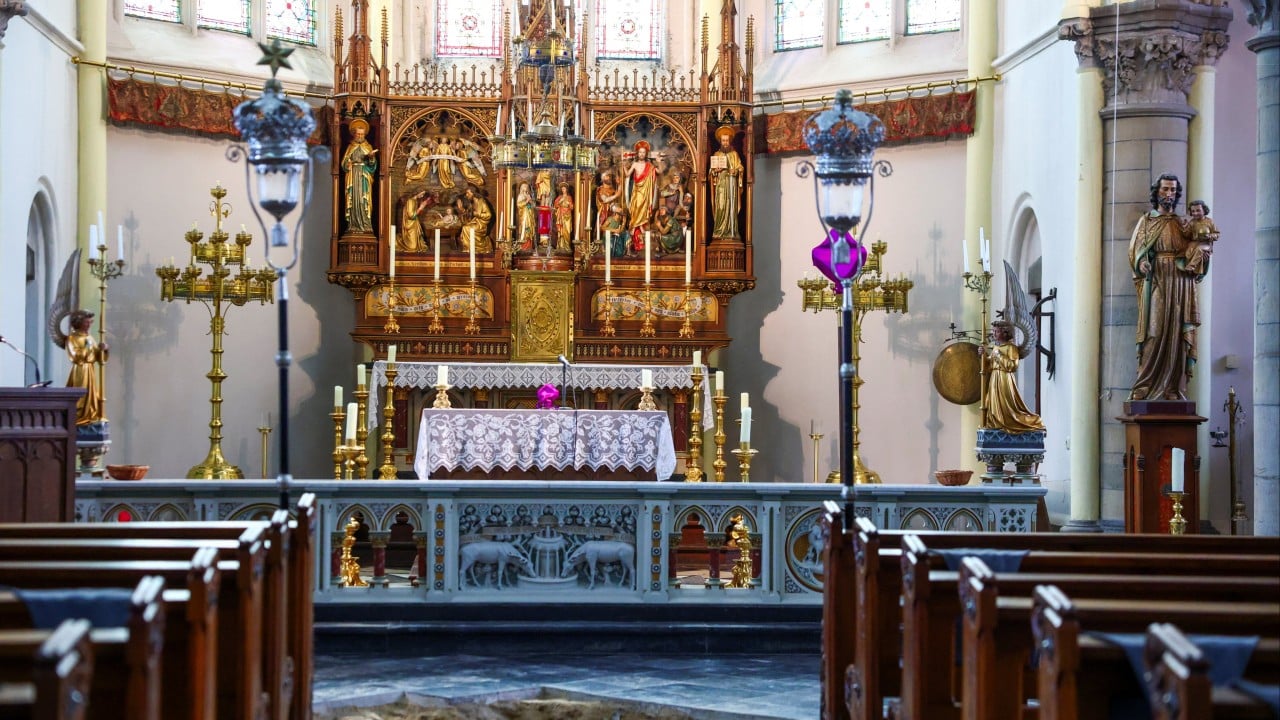
A set of human remains unearthed beneath floor tiles in St Peter and Paul Church in Maastricht may belong to Charles de Batz de Castelmore d’Artagnan, the 17th-century French musketeer who inspired Alexandre Dumas’s fictional hero. Church officials and an archaeologist said the grave was found after part of the church floor subsided in February, and DNA testing has begun to try to establish the skeleton’s identity.
What Happened
Workers discovered a grave containing human remains beneath tiles after part of the floor of St Peter and Paul Church subsided in February, church officials said. The remains were located in front of the church altar, a position that drew immediate attention because historical accounts place the death of the real d’Artagnan at the 1673 siege of Maastricht.
On Wednesday, church officials and an archaeologist described the matter as a high-priority inquiry. Local authorities have launched DNA testing to determine whether the skeleton could indeed be that of Charles de Batz de Castelmore d’Artagnan. The investigation has been characterized by officials as thorough and coordinated, reflecting the potential historical importance of the find.
Background
Charles de Batz de Castelmore d’Artagnan was a 17th-century French cavalry officer who served as captain of the king’s Musketeers under Louis XIV. His life and exploits inspired the fictionalized character d’Artagnan in Alexandre Dumas’s 19th-century novel The Three Musketeers, making his name synonymous with swashbuckling and early modern French military history.
Historically, d’Artagnan is known to have died during the Siege of Maastricht in 1673, a conflict in which French forces fought to capture the city. Maastricht’s layered history, with structures and burial sites dating back centuries, means that finds beneath historic church floors are not unheard of; but a possible identification of such a well-known figure would be exceptional.
Why It Matters
Confirmation that the remains belong to d’Artagnan would be significant for historians, literary scholars and the general public. It would connect a tangible physical trace to a figure who occupies both historical and literary space, offering material evidence from a pivotal moment in 17th-century European warfare and diplomacy.
Beyond scholarly interest, a confirmed identification could stimulate cultural tourism and renewed attention to Maastricht’s role in European history. It would also likely prompt scientific and conservation work to study the remains and the burial context, shedding light on burial practices of the period.
While the discovery has drawn international curiosity, there is no immediate, direct implication for Panama or Latin America. Nevertheless, the case is part of a broader global interest in recovering and studying historic remains, an effort that often involves cross-border scientific collaboration. For now, authorities say DNA testing is the only reliable path to confirmation, and the investigation is being handled as a priority by local specialists.