
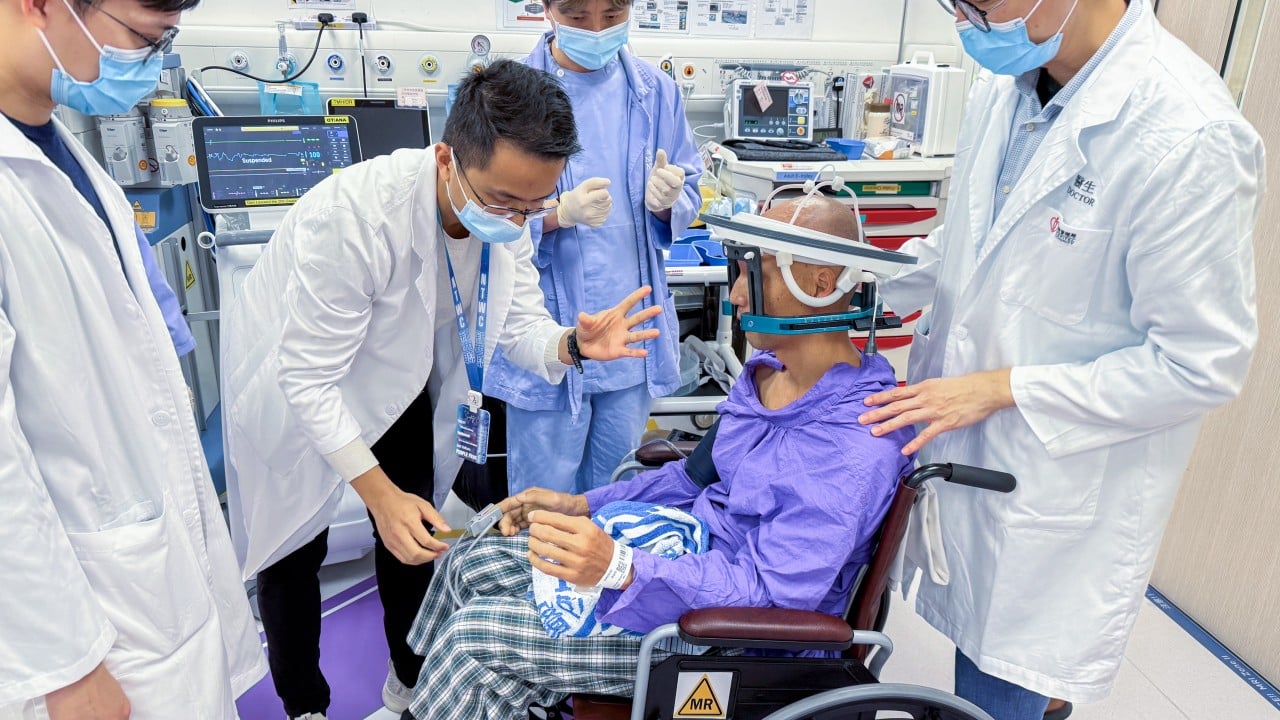
Tuen Mun Hospital has performed Hong Kong’s first magnetic resonance‑guided focused ultrasound (MRgFUS) procedure to treat a Parkinson’s disease patient suffering from uncontrollable tremors, hospital officials said. The non‑invasive, incisionless intervention is being advanced as an alternative to conventional brain surgery and the hospital plans to offer the treatment to about 40 patients over the next two years as part of further research.
What Happened
The procedure, carried out at Tuen Mun Hospital, used MRI guidance combined with focused ultrasound beams to target the brain region linked to tremor symptoms, hospital statements said. The treatment is described as non‑invasive and incisionless; it was applied to one patient with severe, uncontrollable tremors. Hospital officials said they expect to expand the programme and provide the procedure to roughly 40 patients within two years as part of further clinical research.
Background
Magnetic resonance‑guided focused ultrasound (MRgFUS) is a technology that concentrates multiple ultrasound beams on a small target deep in the brain while MRI monitors the location and temperature in real time. The heat delivered by the focused waves can modify or ablate tiny areas of tissue implicated in movement disorders, reducing tremor without the need for open surgery or implanted hardware.
MRgFUS has been adopted in several countries as a treatment option for tremor-dominant conditions, including essential tremor and certain tremors associated with Parkinson’s disease. Because it does not require incisions or permanent implants, it can offer shorter recovery times and avoids some risks linked to invasive brain surgery and device implantation, such as infection or hardware complications.
Why It Matters
The introduction of MRgFUS in Hong Kong marks a notable expansion of local treatment choices for people with debilitating Parkinsonian tremors. For patients who are poor candidates for invasive surgery or who prefer to avoid implanted devices, the procedure can represent an important alternative. By running a research programme targeting around 40 patients over two years, Tuen Mun Hospital aims to gather data locally on safety, clinical outcomes and patient selection.
Regionally, the move could encourage other hospitals in Greater China and nearby health systems to evaluate and adopt non‑invasive neurosurgical technologies. For Panama and Latin America, the development is relevant as it highlights a broader global shift toward image‑guided, incisionless therapies that may eventually inform technology acquisition, training priorities and referral decisions for patients seeking advanced movement‑disorder care. Wider availability of MRgFUS could also affect medical travel patterns if patients currently seeking specialized procedures abroad find options closer to home.
While MRgFUS does not replace all surgical approaches and is not suitable for every patient with Parkinson’s disease, its arrival in Hong Kong adds a clinically meaningful option for managing tremor symptoms and expands the research base needed to refine its uses and long‑term outcomes.